


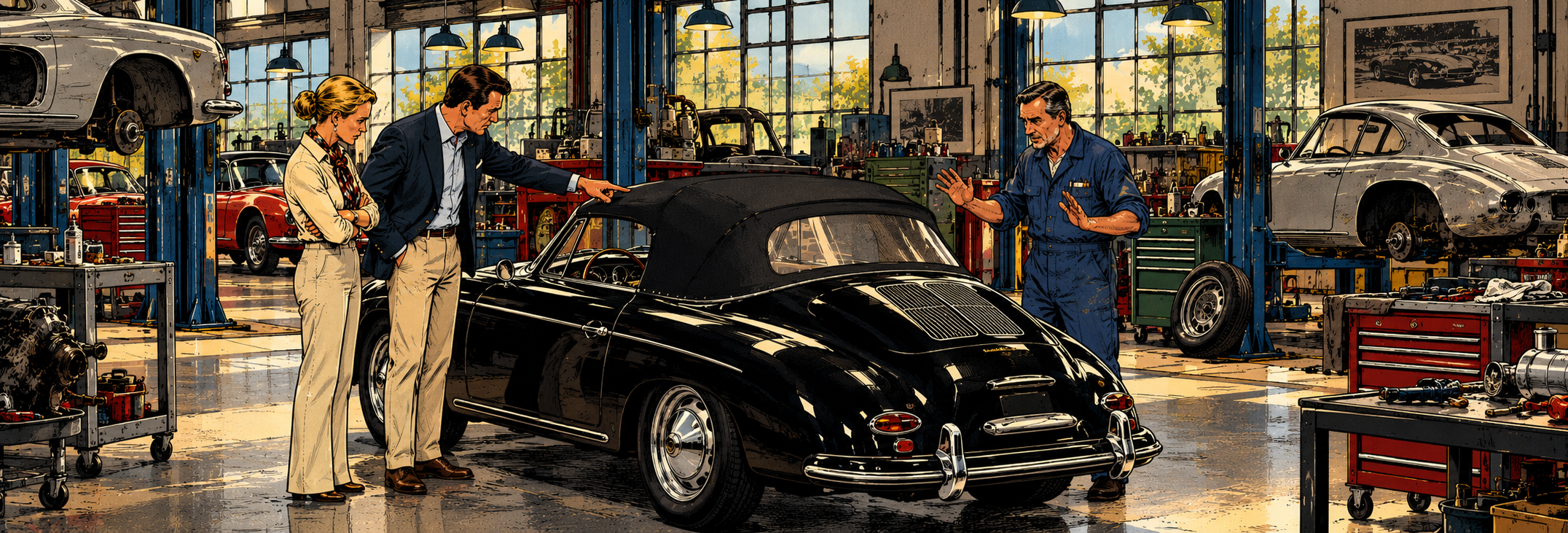
Restoration Agreements & Legal Advice for International Collectors
Restoring a valuable classic car in Germany can be a complex and expensive project. A full restoration may take several years and involve substantial six-figure costs. For international owners, the risks can be even greater when the vehicle is located at a German restoration workshop while the owner lives abroad.
Before work begins, it is therefore important to define what the workshop is required to achieve, how costs will be controlled, which additional work requires approval and how the originality and historic substance of the vehicle will be preserved.
In practice, however, major classic car restorations often begin on the basis of informal discussions, an initial estimate or a relatively general workshop order. Once the vehicle has been dismantled, additional corrosion, previous repairs or mechanical problems may become apparent. Costs increase, deadlines move and disagreements arise about the required quality or scope of the restoration.
A carefully drafted classic car restoration agreement under German law can significantly reduce these risks.
Dr. Louis Rönsberg is a German lawyer based in Munich advising international collectors and owners on classic car restoration agreements and disputes with German restoration workshops.
Classic Car Restoration Agreements under German Law
A complete restoration is fundamentally different from an ordinary vehicle repair.
At the beginning of a project, the true condition of the vehicle may not yet be known. Corrosion, previous repairs or hidden damage may only become apparent once paint and underseal have been removed or the engine, gearbox and body have been dismantled.
A restoration agreement should therefore not simply list the work initially expected. It should also establish a procedure for dealing with additional work, unexpected findings and increasing costs.
For valuable collector cars, a restoration contract should typically address:
- precise identification of the vehicle,
- condition of the car when delivered to the workshop,
- agreed restoration objective,
- dismantling and initial inspection,
- bodywork and paintwork,
- engine, gearbox, suspension and electrical work,
- use of original, used or reproduction parts,
- preservation of historic original components,
- storage and return of removed parts,
- photographic and technical documentation,
- use of subcontractors,
- estimate, cost ceiling or fixed price,
- authorization of additional work,
- notification of cost increases,
- interim payments,
- completion dates and milestones,
- acceptance and rectification of defects, and
- return of the vehicle and its components.
These are also the principal contractual issues identified on the German page.
Defining the Restoration Standard
One of the most important questions is deceptively simple:
What exactly should the finished car be like?
Terms such as “full restoration”, “complete restoration”, “concours condition”, “Condition 1” or “as new” may create very different expectations.
The required result should therefore be described as precisely as possible.
For a historically significant collector car, a technically and visually perfect result is not necessarily the best result. Excessive restoration or unnecessary replacement of historic components can destroy original substance and potentially reduce the vehicle’s collector value.
The agreement should therefore establish whether the primary objective is technical and cosmetic perfection, historical authenticity, preservation of patina and original substance, or a defined combination of these objectives.
Originality, Matching Numbers and Historic Substance
For valuable classic cars, restoration is not merely a technical exercise.
Original body panels, engines, gearboxes, interiors, identification plates, historic paint and manufacturing features can be important to the authenticity, provenance and market value of the vehicle.
The restoration agreement should therefore define which original components must be retained and under what circumstances they may be repaired or replaced.
Particular care is required where work may affect:
- chassis or VIN numbers,
- engine numbers,
- gearbox numbers,
- identification plates,
- original body structures, or
- other historically significant identification features.
The condition of these areas should ideally be carefully documented before irreversible work begins. For particularly rare or valuable vehicles, an independent specialist or marque expert may be appropriate.
Estimate, Cost Ceiling or Fixed Price?
Cost overruns are among the most frequent sources of restoration disputes.
A legally binding fixed price is different from an estimate or an approximate indication of the expected restoration costs.
At the same time, an accurate final price may be difficult to establish before a classic car has been dismantled and inspected.
One practical solution is a staged restoration agreement:
First, the workshop is instructed to dismantle and inspect the vehicle. Once its actual condition is known, the workshop prepares a more detailed scope of work and cost calculation. Further work proceeds only after approval by the owner. This approach is also expressly discussed on the German page.
For an international owner, a clear written approval procedure is particularly useful because it reduces later disputes about what was agreed during telephone calls or informal conversations.
Additional Work and Unexpected Costs
Once a vehicle has been dismantled, a workshop may discover work that was not originally anticipated.
That does not mean that the financial scope of the restoration must remain unlimited.
Under German law, § 649 BGB addresses situations in which a substantial overrun of an estimate is to be expected. In practice, disputes frequently concern whether particular work was already included in the original contract or was subsequently authorized as additional work.
A restoration agreement should therefore specify how additional work is approved.
For substantial projects, it can be sensible to require the workshop to provide a written description and cost indication before carrying out additional chargeable work.
Restoration without a Written Contract
The absence of a signed written agreement does not mean that there is no contract.
Under German law, a restoration agreement may also be concluded orally or through the parties’ conduct. The main problem is usually proving its precise content.
Questions may include:
What work was commissioned?
What cost range was discussed?
Was a completion date agreed?
Which additional work required prior authorization?
Relevant evidence may include estimates, invoices, emails, messages, photographs, notes of conversations and witness evidence. Rechtsanwälte
For international owners, it is therefore particularly advisable to confirm significant decisions and cost approvals in writing.
Interim Invoices and Payments
Major restorations may generate invoices over several months or even years.
Owners should be able to understand what specific work each invoice relates to and what stage the restoration has reached.
For substantial projects, it is useful to maintain a running record of:
- invoices,
- payments,
- completed work,
- authorized additional work, and
- outstanding work.
Payment of substantial invoices does not necessarily establish that all invoiced work was properly performed or that every additional service was validly commissioned. Conversely, the workshop may have legitimate claims for properly authorized and completed work.
Delays in Classic Car Restoration
Classic car restorations often take longer than originally expected. Delay alone does not automatically give rise to a legal claim.
The legal position will depend in particular on whether a binding completion date or specific milestones were agreed.
For extensive restorations, useful milestones may include:
- completion of bodywork,
- completion of engine and gearbox work,
- paintwork,
- commencement of final assembly, and
- completion and road testing.
If progress effectively stops for an extended period, it may become necessary to consider formal deadlines and the legal consequences of continued delay.
Defective Classic Car Restoration
A German restoration workshop is generally required to deliver the result agreed with the owner.
Typical disputes concern:
- defective bodywork,
- poor welding,
- inadequate corrosion protection,
- defective paintwork,
- engine or gearbox defects,
- improper assembly,
- unauthorized parts,
- damage to or loss of original components, and
- deviation from the agreed restoration objective.
For valuable collector cars, determining whether restoration work meets the required standard may require an expert with specific experience of classic vehicles.
Before another workshop changes or corrects disputed work, the evidentiary consequences should be considered carefully.
Acceptance of the Restored Vehicle
Formal acceptance (Abnahme) has significant consequences under German contract law.
International owners should therefore avoid treating collection of the vehicle as a purely logistical matter.
For an extensive restoration, it may be advisable to carry out a structured final inspection, document remaining defects and incomplete work, and record any reservations in writing.
For particularly valuable cars, an independent expert can assist with the final inspection.
What Happens to Removed Original Parts?
Even unusable original components may have considerable historical or financial value.
Engines, gearboxes, body panels, instruments, interior components and other original parts may contribute to the documented history of a collector vehicle.
The restoration agreement should therefore specify that removed components are retained and returned to the owner unless otherwise agreed.
This can become particularly important when the vehicle is later sold and its originality and restoration history have to be documented.
Restoration Documentation
Comprehensive documentation can become an important part of the history of a valuable classic car.
Photographs of the vehicle before dismantling, exposed body structures, original components and individual stages of restoration can help establish:
- what original substance existed,
- which components were repaired,
- which parts were replaced, and
- what work was actually performed.
Invoices, parts lists, workshop records and expert reports can supplement the photographic documentation.
A complete restoration file may be important not only in a legal dispute but also for the vehicle’s future provenance, marketability and value.
Terminating a German Restoration Agreement
When costs escalate, work stops or confidence in the workshop is lost, an owner may consider terminating the restoration contract.
This decision should not be taken prematurely.
The financial consequences can depend substantially on why and on what legal basis the contract is terminated. Before termination, it is important to establish:
- what work has already been performed,
- what payments have been made,
- which invoices remain disputed,
- whether defects exist,
- where all vehicle components are located, and
- how the car and its parts can be recovered.
The German page specifically cautions that premature termination can have significant financial consequences.
Recovering the Vehicle from a German Restoration Workshop
For an international collector, this can become the most urgent issue.
The restoration workshop may have possession of a partially dismantled vehicle, while the parties dispute invoices or the quality of the work.
German law may give the workshop certain security or retention rights in connection with outstanding claims. At the same time, it may be necessary to determine precisely which parts belong to the vehicle, where they are located and in what condition they must be returned.
This is another reason why a detailed inventory at the beginning of the restoration and continuous photographic documentation are valuable.
Expert Evidence in Restoration Disputes
Disputes over restoration quality frequently depend on technical expert evidence.
Evidence should ideally be preserved before another workshop alters or removes the disputed work.
For substantial disputes, a German independent evidentiary proceeding (selbständiges Beweisverfahren) may be appropriate. A court-appointed expert can examine the condition of the vehicle, alleged defects and potentially the work required to remedy them.
This can be particularly important where a valuable vehicle remains in Germany while its owner lives abroad.
Legal Advice for International Classic Car Owners
International clients do not generally need to be physically present in Germany for the initial legal assessment.
The restoration agreement, estimates, invoices, photographs and correspondence can be reviewed electronically, and communication can take place in English.
Where necessary, we can coordinate the legal strategy with technical experts in Germany and assess issues concerning German law, jurisdiction, evidence preservation, termination of the restoration agreement and recovery of the vehicle.
German Lawyer for Classic Car Restoration

Dr. Louis Rönsberg is a German lawyer and partner at SLB LAW in Munich and has many years of experience in classic car law.
He advises owners and collectors before major restoration projects on the review and drafting of restoration agreements and represents clients in disputes involving cost overruns, defective restoration work, delays, workshop invoices and recovery of vehicles.
A particular focus is the combination of contract law and litigation strategy: What exactly was agreed? Which additional work was authorized? How can the original and current condition of the vehicle be proved? Is an independent expert report or court-supervised preservation of evidence required?
FAQs
Should I have a German classic car restoration agreement reviewed before work begins?
For a valuable vehicle, this is often advisable. The agreement should define the restoration objective, scope of work, costs, approval of additional work, use of original parts, completion schedule, documentation and return of removed components.
Can a German restoration workshop exceed its original estimate?
The answer depends on the contractual basis of the estimate and the circumstances of the project. A fixed price must be distinguished from an estimate. If substantial additional costs become foreseeable, German law may impose relevant notification obligations, and the question of whether additional work was actually authorized can become decisive.
Do I have to pay for restoration work that I did not authorize?
Not necessarily. It must be determined whether the work was included in the original agreement, subsequently authorized or otherwise provides a legal basis for payment. Written approval procedures can significantly reduce disputes.
What can I do if the restoration is defective?
Depending on the circumstances and statutory requirements, remedies may include subsequent performance, remedying defects through another workshop and recovering relevant costs, reduction of remuneration, rescission or damages. Before another workshop alters the vehicle, both the workshop’s opportunity to remedy defects and preservation of evidence should be considered.
What can I do if my restoration has been delayed for years?
The legal position depends partly on whether a binding completion date or milestones were agreed. Depending on the circumstances, a formal deadline may be appropriate before further remedies or termination are considered.
What happens to original parts removed during restoration?
The agreement should expressly address their retention and return. Original engines, gearboxes, body panels, interior parts and other components may remain important to the vehicle’s authenticity, history and value even if they are no longer technically usable.
Can you represent me if I live outside Germany and my car is at a German restoration workshop?
Yes. Documents and photographs can be reviewed electronically and communication can take place in English. Where necessary, technical evidence can be coordinated in Germany, and legal representation can include disputes over costs, defects, termination and recovery of the vehicle.

Restoring a Classic Car in Germany?
If you are planning a substantial restoration with a German specialist workshop, we can review or draft the restoration agreement before work begins and help define costs, additional work, originality, documentation and completion milestones.
If the project is already in difficulty, we advise international owners on cost overruns, defective restoration work, delays, disputed invoices, termination and recovery of the vehicle.