


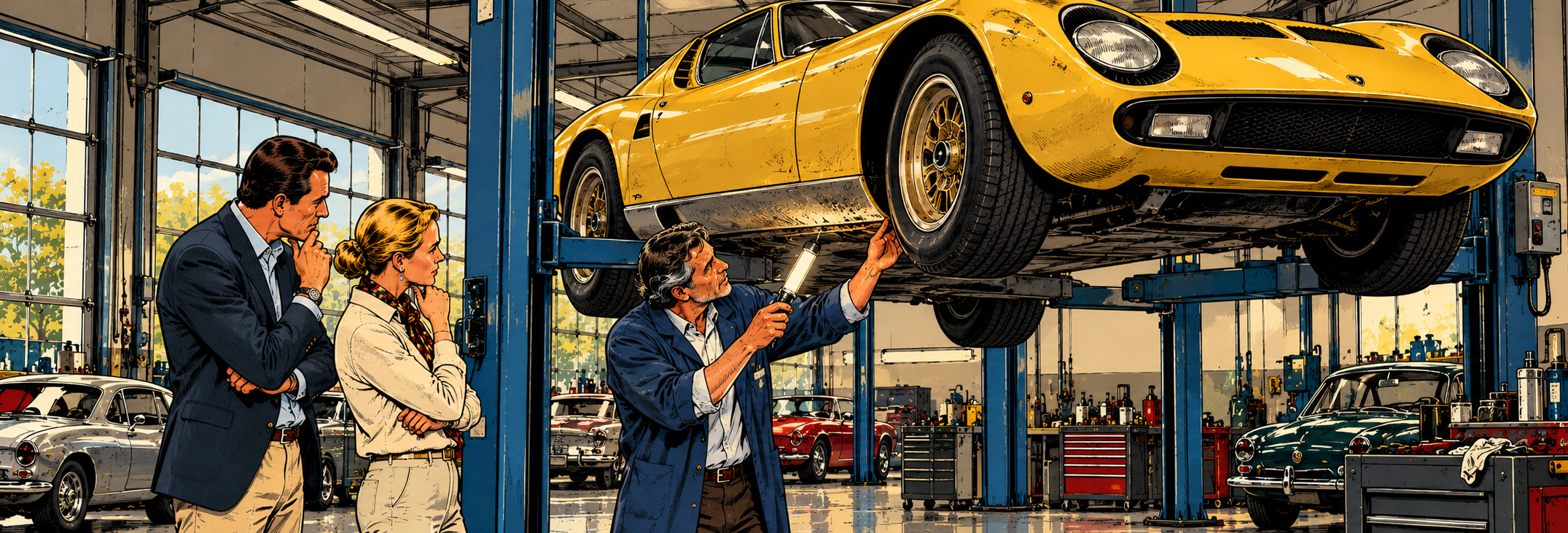
Expert Evidence for Defects, Authenticity, Matching Numbers, Restorations and Disputes
In disputes involving valuable classic and collector cars, the legal position alone is often not decisive. The outcome may depend on whether technical and historical facts can actually be proved.
Is the engine original? Does the car have matching numbers? Was accident damage already present when the vehicle was purchased? Was a restoration carried out properly? Did a German workshop cause an engine failure? What was the vehicle worth before an accident, and has its market value been permanently reduced?
Questions such as these often require evidence from a specialist classic car expert.
For international owners, buyers and sellers involved in a dispute in Germany, however, obtaining an expert report is only part of the task. It is equally important to determine which facts must be proved, who bears the burden of proof, which type of expert is required and whether the existing condition of the vehicle must be preserved before repairs or alterations are carried out.
Dr. Louis Rönsberg is a German lawyer based in Munich advising international clients on expert evidence and evidence preservation in disputes involving valuable classic cars, historic sports cars and racing cars. He coordinates technical evidence with the legal and procedural requirements of potential proceedings before German courts.
When Is a Classic Car Expert Report Necessary?
There is no single type of “classic car expert report”.
Depending on the dispute, an expert may be required to assess:
- the technical condition of the vehicle,
- market value,
- replacement value,
- restoration or reinstatement value,
- accident damage,
- repair costs,
- diminution in value,
- restoration quality,
- authenticity,
- matching numbers,
- vehicle identity,
- chassis, engine and gearbox numbers,
- previous repairs or modifications, or
- the cause of a technical failure. Rechtsanwälte
The purpose of the report should therefore be established before an expert is instructed.
A valuation report prepared for insurance purposes serves a different function from a technical report intended to support rescission of a purchase agreement or expert evidence required in German court proceedings.
The Right Expert for the Right Question
Not every automotive expert is suitable for every classic-car dispute.
A conventional motor-vehicle expert may be highly qualified to assess collision damage but may lack the specialist knowledge required to determine whether the engine in a rare historic racing car corresponds to its original factory specification.
Conversely, an internationally recognised marque expert may have exceptional knowledge of a particular manufacturer, production series or racing history without being the appropriate expert for an entirely different technical question.
Complex disputes can require several areas of expertise:
automotive engineering + bodywork + marque expertise + vehicle history + collector-car market knowledge.
The German source page therefore deliberately emphasizes that the expert’s qualifications should correspond to the specific evidential question, rather than merely to the broad category of “classic cars”.
Expert Inspection Before Buying a Classic Car in Germany
For a high-value vehicle, an expert inspection may be advisable before the purchase agreement is signed.
Depending on the car, an inspection may address:
- corrosion,
- previous accident damage,
- repairs to the chassis or body,
- engine and gearbox condition,
- suspension and brakes,
- restoration quality,
- originality of important components, and
- identification numbers.
For particularly valuable or historically significant vehicles, a technical inspection may need to be supplemented by an examination of the car’s history, manufacturer records and other historical documentation.
An expert inspection does not, however, replace legal review of the purchase agreement. Equally, a carefully drafted purchase agreement cannot eliminate technical uncertainty about the vehicle.
Authenticity and Matching Numbers
Authenticity disputes require particular expertise.
An examination may need to establish whether chassis, engine and gearbox numbers appear authentic and correspond to historical factory records.
Relevant evidence can include:
- the form and location of number stampings,
- typeface and manufacturing characteristics,
- traces of previous alteration,
- manufacturer records,
- production data,
- historic registration documents, and
- earlier restoration records.
If there are doubts about matching numbers or vehicle identity, an expert with specific knowledge of the particular marque and model may therefore be considerably more useful than a general automotive expert.
Vehicle Identity – Preserve the Evidence Before Altering It
Suspected alterations to a chassis number or other identification feature require particularly careful handling.
A suspicious number should not simply be ground down, exposed, restamped or otherwise altered before the existing condition has been properly documented.
The very marks produced by earlier manipulation may themselves constitute important evidence.
Before any intervention, it may therefore be necessary to document:
- the original appearance of the number,
- its precise location,
- visible signs of alteration,
- paint and material layers, and
- other identifying characteristics of the vehicle.
For economically significant disputes, the further question is whether private documentation is sufficient or whether evidence should be preserved through a German court procedure.
Expert Evidence in Restoration Disputes
An expert report is often indispensable where an expensive classic-car restoration is alleged to be defective.
Technical questions may include:
- Which work was actually performed?
- Was bodywork carried out properly?
- Was corrosion correctly removed?
- Does the paintwork meet the agreed standard?
- Were the engine and gearbox properly rebuilt?
- Were agreed original components used?
- Which defects remain?
- How can they be remedied?
- What will the remedial work cost?
Timing is crucial.
If another workshop completely rectifies the defects before they have been documented, it may later become difficult or impossible to establish what the original restoration workshop actually did wrong.
Evidence should therefore generally be preserved before remedial work begins.
Evidence in Classic Car Workshop Disputes
The same principle applies to repair disputes.
If a German workshop maintains that an engine failure occurred independently of its work while the owner alleges an installation or repair error, the technical cause must be established.
Typical disputes involve:
- engine and gearbox failures,
- incorrect adjustments,
- defective bodywork,
- damage during test drives,
- improper installation of components, and
- loss or damage of original parts.
The expert’s instructions should be formulated precisely.
Asking simply whether a workshop “did a bad job” is generally less useful for subsequent litigation than identifying the specific technical cause of the damage and whether it is causally connected with the work performed.
Evidence Preservation After an Accident
After an accident involving a valuable collector car, the damaged condition should be comprehensively documented before repairs materially alter it.
This is especially important where the repair will remove or replace historic original material.
An expert may need to determine:
- which original components were damaged,
- whether they can be repaired,
- whether replacement is necessary,
- the technically and historically appropriate repair method,
- necessary repair costs,
- the vehicle’s pre-accident market value, and
- any remaining diminution in value.
With particularly rare cars, this may require both technical expertise and specialist knowledge of the collector-car market.
Private Expert Report or Court-Appointed Expert?
This distinction is particularly important for international clients unfamiliar with German civil procedure.
A private expert report (Privatgutachten) is commissioned by one of the parties. It can be extremely useful for investigating technical issues, preparing a claim and substantiating the party’s factual case.
However, a privately commissioned report is generally not equivalent to expert evidence obtained by the German court.
If technically relevant facts remain disputed in subsequent civil proceedings, the court may appoint its own expert.
This is why a private expert should ideally be instructed with potential future litigation already in mind.
A well-prepared report should clearly document:
- what was examined,
- which factual material was considered,
- which methodology was used, and
- how the expert reached the conclusions.
Independent Evidence Proceedings Before German Courts
German civil procedure provides a particularly useful mechanism for disputes in which physical evidence may change or disappear.
Under §§ 485 et seq. of the German Code of Civil Procedure (ZPO), evidence can, under certain conditions, be obtained through an independent evidentiary proceeding (selbständiges Beweisverfahren) even before the principal lawsuit has been filed.
A court-appointed expert may, for example, be asked to establish:
- the condition or value of the vehicle,
- the cause of physical damage or a defect, or
- the measures and costs required to remedy the damage or defect.
For valuable classic cars, this can be particularly important where the vehicle needs to be repaired, dismantled or otherwise altered before the main dispute can be resolved.
When Is an Independent Evidentiary Proceeding Appropriate?
Depending on the individual circumstances, a selbständiges Beweisverfahren may be considered in disputes involving:
- defective restorations,
- serious workshop defects,
- engine or gearbox failures,
- substantial accident damage,
- disputed vehicle condition or value,
- authenticity or vehicle-identity issues, and
- technically complex defects discovered after purchasing a classic car.
It is not automatically the best solution in every case.
The procedure involves costs and can take considerable time. In a straightforward case, a qualified private expert report may be sufficient. In other circumstances, filing the principal action immediately may be more efficient.
The procedural strategy should therefore be determined before the vehicle is altered.
The Expert Question Can Decide the Case
An expert determines and assesses technical facts. The legal conclusions are for the court.
This distinction makes the formulation of the expert questions particularly important.
Rather than asking whether a classic car is simply “defective”, relevant questions might be:
- Which corrosion damage existed when the vehicle was delivered?
- Was existing damage caused by an earlier improper repair?
- Is the installed engine the engine originally supplied with the vehicle?
- Has an identification number subsequently been altered?
- Were specified restoration works carried out professionally?
- What work is required to rectify the identified defects?
- What will that work cost?
For litigation, the technical question should therefore be derived from the legal facts that actually need to be proved.
Using the Evidence in Subsequent Litigation
The result of an independent evidentiary proceeding can be used in subsequent principal proceedings.
Its purpose is therefore not merely to create a photographic record of the vehicle at a particular moment.
A court-appointed expert report may provide the basis for deciding whether to:
- pursue the claim,
- defend against a claim,
- negotiate a settlement, or
- commence or continue litigation.
In some cases, clarification of the disputed technical facts can itself facilitate an out-of-court settlement.
Who Selects the Court-Appointed Expert?
In German court proceedings, the expert is generally selected by the court.
The parties can, however, be heard regarding the expert and may, under appropriate circumstances, suggest suitable experts.
This can be important for exceptionally rare vehicles.
A technically qualified general automotive expert will not necessarily possess the specialist knowledge required to assess the authenticity of a rare historic racing car or the manufacturing characteristics of a particular model.
The need for marque- or model-specific expertise should therefore be identified early.
What Documents Should International Owners Preserve?
If a dispute is developing, relevant material should be secured as early as possible.
This may include:
- purchase agreement,
- original advertisement,
- auction catalogue or sales brochure,
- emails and messages,
- invoices,
- workshop orders,
- restoration records,
- previous expert reports,
- manufacturer certificates and data cards,
- registration documents,
- historic photographs,
- photographs of the vehicle’s present condition,
- engine and component numbers, and
- provenance and vehicle-history documentation.
Online advertisements should also be preserved promptly and in full, including photographs.
Years later, the original advertisement may become important evidence of what the seller represented about the car.
Do Not Repair or Alter the Vehicle Too Soon
For an owner involved in a developing dispute, one principle is particularly important:
Preserve the evidence before repairing or altering the vehicle.
A defective engine should not automatically be completely dismantled, a suspicious chassis number should not be altered and defective restoration work should not be removed before considering whether the existing condition is still required as evidence.
This does not mean that the vehicle must remain untouched for years.
The objective is to establish an appropriate evidence-preservation strategy first, so that necessary work can subsequently proceed without destroying evidence required for the claim.
Burden of Proof in German Classic Car Litigation
The existence of a technical defect alone does not determine the outcome of a legal dispute.
It is equally important to establish which party has to prove which facts.
Depending on the claim, relevant issues can include:
- the condition of the vehicle at delivery,
- the content of an agreed characteristic,
- when a defect arose,
- the cause of technical damage,
- the scope of commissioned workshop work,
- the seller’s knowledge of a defect,
- necessary repair costs, and
- diminution in value.
Technical investigations should therefore be designed from the outset around the facts that matter to the applicable legal claim.
German Lawyer for Classic Car Expert Evidence
Dr. Louis Rönsberg is a German lawyer and partner at SLB LAW in Munich with many years of experience in classic car law and complex civil litigation.

His practice includes technically and factually complex disputes involving defects, authenticity, matching numbers, vehicle identity, restorations, workshop work and damage to valuable collector vehicles.
He advises clients on the selection of appropriate experts, formulates legally relevant expert questions and coordinates technical evidence with a view to subsequent negotiations or litigation. Where appropriate, he applies for and conducts independent evidentiary proceedings under §§ 485 et seq. ZPO and represents clients in subsequent principal proceedings.
For international owners, the central questions are therefore considered together:
What must be proved? Who bears the burden of proof? Which expert has the necessary specialist knowledge? And how must the vehicle be documented so that the evidence can later be used effectively in Germany?
FAQs
Should I have my classic car inspected before it is repaired?
If a dispute is possible, generally the relevant condition should first be properly documented. Repairs, dismantling or further restoration may alter or destroy evidence needed to establish the cause and extent of a defect or damage. The appropriate method of preservation depends on the individual case.
What type of expert do I need for a classic car dispute in Germany?
That depends on the issue to be proved. Accident damage may require an automotive damage expert, while authenticity, matching numbers or the identity of a rare historic vehicle may require marque- or model-specific expertise. Complex cases can require several disciplines.
Is a private expert report sufficient for a German court case?
A private expert report can be valuable for analysing the case and substantiating technical allegations, but it is generally not equivalent to expert evidence obtained by the court. If relevant technical facts remain disputed, the German court may appoint its own expert.
What is an independent evidentiary proceeding in Germany?
A selbständiges Beweisverfahren under §§ 485 et seq. ZPO can, under certain conditions, allow expert evidence to be obtained by a German court before the principal lawsuit. It can be particularly useful where the present condition of a vehicle must be established before repair or alteration.
Can expert evidence establish whether a classic car has matching numbers?
Potentially, yes. The examination may involve engine, gearbox and chassis numbers, their location and manufacturing characteristics, evidence of alteration, manufacturer records and historical documentation. For rare vehicles, a marque specialist may be required.
Should I allow another workshop to rectify a defective restoration immediately?
Doing so before preserving the evidence can create problems. Once defective work has been removed or corrected, it may become difficult to establish what the first workshop did incorrectly. Evidence preservation should therefore be considered before substantial remedial work begins.
Can you coordinate an expert inspection if I live outside Germany?
Yes. For an international owner with a vehicle in Germany, the legal issues and documentation can generally be reviewed remotely. Where technical evidence is required, the appropriate expert examination in Germany can then be coordinated with the legal questions that need to be proved.

Need to Preserve Evidence in a Classic Car Dispute in Germany?
If you have discovered serious defects, questionable matching numbers, doubts about vehicle identity, defective restoration work, workshop damage or accident damage, consider preserving the evidence before the vehicle is repaired, dismantled or otherwise altered.
We assess the legal issues, identify the facts that need to be proved and, where required, coordinate an appropriate classic-car expert examination in Germany. If judicial preservation of evidence is appropriate, we can apply for and conduct an independent evidentiary proceeding under §§ 485 et seq. ZPO.